The Blood Skirt by Ashlee Green
This story of Saera Burns, Hawaiian "artist-seamstress-goddess," comes to you from writer Ashlee Green. Ashlee contacted us about writing a guest post to share Saera's story and empower women to celebrate their cycle. We hope you enjoy the post and share your thoughts in the comments!
“Pain, shame, blame, fear, ‘Yuck!’, ‘Hide me!’, ugly, stinky”: In the words of multidimensional seamstress Saera Burns, these are the ways that girls in our North American culture are taught to feel about puberty and menstruation.“Except for us old souls,” Saera continues with bright laughter, her skin glowing from her second trimester of pregnancy. “Nothing gets past us.”
Nothing: That is to say, not even preconceived notions of how a woman should feel about her period. So, when Saera was first taught to use disposable tampons and pads for what she refers to as her “moon cycle,” she had second thoughts.
For her, accepting her moon cycle was all a part of her journey of self-love, a concept that has taken Saera 22 years to virtually perfect:
“My whole life has been the journey of not hiding things. Unfortunately, in the past and in the present, I have to admit, there are a lot of women who have had to hide and feel repression of the blood.”
While she confesses to having to do some reprogramming of her own, Saera says that as she ages, she remains resolute on creating her own reality based on self-love and acceptance, and is a “stubborn,” in a sense, opponent of society’s mainstream ways.
“As I grow older,” she says, “I find more people that are stubborn enough and our stubbornness is prevailing and now we have a new paradigm forming.”
Saera started tracking her cycle and realizing the correspondence it had to her emotional state: Challenging months full of obstacles or injuries that she hadn’t yet accepted and released caused painful cycles, whereas clear months in which she moved fluidly through problems and lessons made for clear, mild ones.
During this time, tampons also became an issue for her.
“It was me showing my body, ‘I'm not ready to fully let this flow out of me. I want this to slowly condense and I want to absorb this,’” Saera explains.
It was not long before Saera asked herself, “What if I just removed the pad too?” No one ever suggested that.
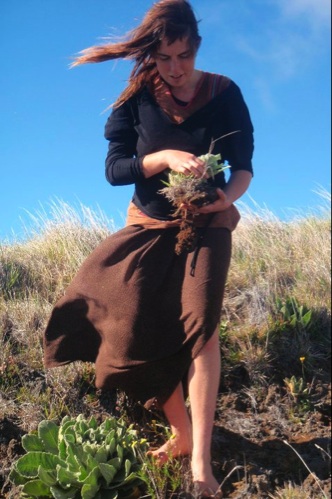
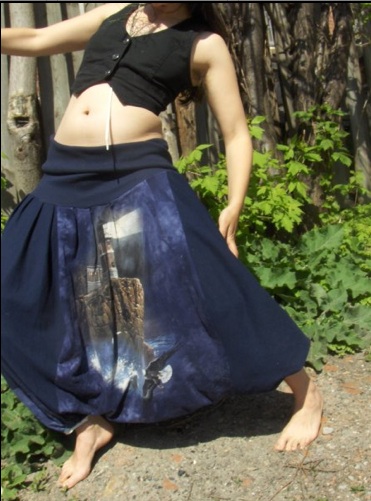
“That was this whole groundbreaking lesson I started teaching myself,” she says. “I'm going to remove the pad. And what am I going to do instead? I'm going to wear all black; I'm going to wear many layers of black. I'm going to wear skirts, long skirts: Long, black, multilayered skirts.” After a few trials and errors, Saera eventually perfected her blood skirt prototype.
Once she started adapting the blood skirt into her life, Saera stopped wearing black throughout the whole rest of her cycle. To her, black meant a time for her moon—a time for bleeding.
“I started associating black with so much power that I couldn't just wear black in the middle of the cycle,” she says.
“It made my blood far more accessible to the earth. If I was walking, and all of a sudden I really felt like I wanted to offer it to this tree, even if there was a bunch of people around, I could just sit, move the skirt a little bit, and offer my blood and have people not even notice that is what’s going on, because it is so past peoples’ comprehensions.”
For Saera, wearing a blood skirt during her moon cycle serves to defy the oftentimes restrictive laws of womanhood that she had been taught and to reclaim her connection to the natural cycle that all women are experiencing.
Girls everywhere should craft blood skirts, Saera says, to “extend their own personal boundaries,” and ideally, to gain absolute comfort with all of their bodily functions.
Like smell, for example:
“Yeah, stinky! Part of our smell is how we figure out if we're healthy or not,” Saera says with a smile. “If you don't like your smell, then you've got to examine what you're ingesting and where you're at emotionally, because our emotions connect with which pheromones come off of us.”
According to Saera, once you are ultimately comfortable with your smells and sounds and cycle, a whole new world will open to you.
“That time of the month doesn't have to be a dread. It can be a fun exploration,” she says.
Saera lives at PeleAina Peaceful Arts Farm in Kurtistown, HI. View and shop her creations at whymz.net.