
The Trampled Rose: Maeza's Story
We last heard from Becky when she reported on how Moon Cups were changing the lives of Ethiopian women. Here is her latest update from the Trampled Rose.
Hello!
The best part of being at the Trampled Rose is seeing the transformation of the women in our program. They arrive almost unable to hold their heads up and then they graduate full of confidence, hope, and new direction for their future. The part I like the least is writing reports and project proposals.
Unfortunately for me, I have spent the last few weeks writing reports about our past activities and proposals for the future. There are so many good things coming and I promise to keep you informed as more details are worked out. For now, it's been almost six years since we first opened our gate to do our best to help. Thank you for all your encouragement and help over these years. Can you believe that we've helped over 1500 women?
I thought you might like to read the story of Maeza I just wrote for one of those reports I was complaining about. I attached her photo. You can see her when she arrived.
Love,
Becky Kiser
Trampled Rose, Inc.
www.trampledrose.org
These are the grateful words of Maeza herself : “This is the best time in my life! I started to be human again. I know how to write and calculate money. I am happy. I never imagined getting such a chance in my life.” Her husband said “I am so happy and thankful! The trampled Rose helped us financially because my wife knows how to get additional income to change our life. Thank you!”
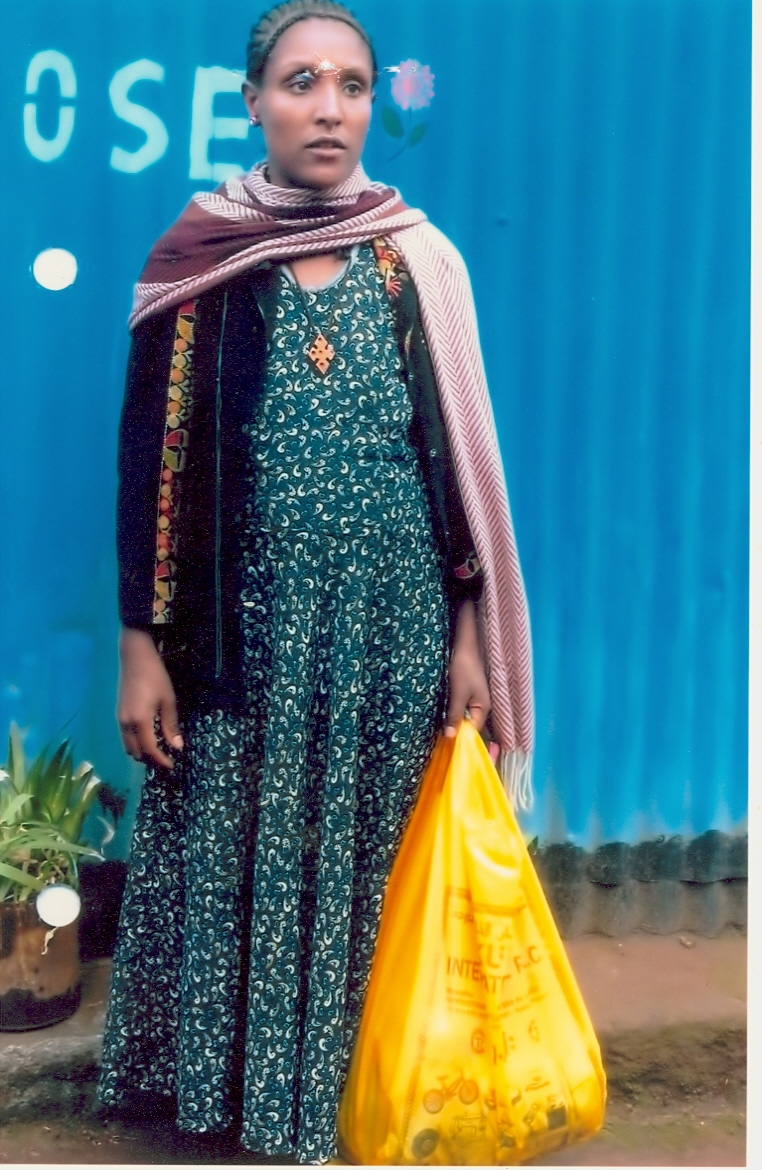 But Maesa’s life has not always been so happy. When Maeza Miskir arrived at the Trampled Rose her life had already been a hard one. She was born twenty eight years before in the Amhara region in the northern part of Ethiopia to a sustenance farming family. She has four other sisters and two brothers. When she was young there was no school in her area and her parents didn’t consider education important for a girl. They wanted her to get married and be safe instead.
Although Maeza was only seven years old and had no desire to get married she was given to her husband to begin the duties of a wife. This was a terrifying experience for her so as soon as she had the chance she ran away from the man she hardly knew. Because of her illiteracy life was difficult and she married again.
In her second marriage she became pregnant with her first child. In the area where she lived there were very scarce medical services available so most of the women give birth in their own homes or the home of their in laws with a traditional birth attendant. These birth attendants have limited knowledge about difficult child birth deliveries. Maeza was in labor for five full days. At the end of her labor the baby was stillborn.
The pressure on her birth canal had caused a lack of blood flow to her bladder and she developed a vescovaginal fistula. She began to leak urine uncontrollably.. Her husband was offended by her condition and especially her smell. He asked her to leave so he could marry another woman who could have children and he wanted to be free of Maeza.
Maeza’s second husband returned her to her family home. She lived with them for two years when she heard about surgery at a Fistula Hospital near her region. But her depression and bad luck increased when she underwent her surgery only to discover that she seemed to be incurable. The leaking continued. She lived for one more year in hopelessness until she met a new educated man. He loved her and told her that he was willing to marry her because you never know what can happen in the future.
By this time Maeza had been leaking urine down her legs for more than seven years.
One day she was approached by the Amhara development association who was contacting women in their area with fistula on behalf of the Trampled Rose, Inc. Maeza and her husband jumped at the chance for Maeza to learn to read and write and begin a business of her own. Because the problem of fistula is so prevalent in the Amhara region of Ethiopia, Maeza’s sister in law also suffered from fistula. They decided to travel together with the transportation service provided by the Trampled Rose to the city of Addis Ababa.
Maeza was frightened, hungry, tried and dirty when she arrived at the gates of the Trampled Rose. During her orientation she was taught about the causes and cures for fistula. She was especially relieved to learn that fistula is not a curse from God but only a medical condition caused by her prolonged labor. As part of her orientation she was taken to a hospital to be checked for other diseases that could make her studies difficult. She was also examined by an expert fistula surgeon to make sure that her fistula was indeed curable. Her pleasure was immeasurable when she discovered that she did indeed have a chance to be cured by surgery.
Maeza began her literacy class during her first week. She was taught the alphabet by using small stones and sticks to make letters. She could read 180 words in her first week. This quick process gave her courage to try more. In fact, Maeza was the outstanding student in her graduation from the Trampled Rose. She also enjoyed the social atmosphere of being with twenty seven other women with her same problems.
After Maeza could read and write she began her business training of Sambusa making, ironing, traditional bread baking , and jewelry making. She also learned how to manage money and how to make a business plan. She even enjoyed a field trip to a bank to learn how to open her own account. She was surprised because she thought that banks were only for rich people.
Maeza’s surgery was indeed successful and she returned to her happy husband to open her own small shop selling Sambusa, traditional beer, tea, and taking in ironing with the startup capital she received from the Trampled Rose.